Thursday, June 16, 2011

"On Holy Ground.:


 “And He said, Draw not nigh hither: put off thy shoes from off thy feet, for the place whereon thou standest [is] holy ground.”  Exodus 3:5

  I entered back in to Egypt and back to Dahab and stayed in a cheap dorm room at the beach, spending days walking along the edge of rocky beach in both directions, enjoying the wind and warm sun, and staring out at windsurfers sweeping over the sparkling blue of the red sea with the desert town creeping right to the edge and brown and barren mountains looming above in the background.  I walked several miles in each direction until the pathways ended and walked along rocky uneven beaches with scattered sand.  The farther out I walked, the prettier everything became, narrow beaches of stone opening to far stretches of sand, and huddled restaurants and hoards of sun bathers and beach goers left in the distance and traded in for the tranquil hush of seclusion.  Is there some direct correlation between solitude and beauty, between serenity and silence?  My best and worst moments are perhaps wrapped up and mingled in the lonely moments of being all alone, but the lonely moments of some solitary beach, some walk through a warm wind, or a quiet moment a world away, these are sharply outlined and bunched like bouquets of babies’ breath.  They are beautiful; they are the accessories that make a life. 


 Staring out across the narrow waters along the coast of Dahab, I looked across the sea to the mountains of Saudi Arabia and also Jordan.  It is almost painful for me to know I am so close to a country, and yet not visit it, and I had to put off Saudi Arabia because of difficulties with a Visa, and while in Jordan I came within a mere mile of the Israeli border, and yes, it nearly hurt me to know such a place was so close, and yet I would not visit those countries.  I still have many travels and adventures to plan and look forward to, and I will cross those borders some day.
  One day in Dahab I spent snorkeling in Dahab’s famous Blue Hole, a bumpy ride beyond the city, passing camel camps and tents and the omnipresent mountains of the Sinai Peninsula.  The Blue Hole is a deep drop of water encircled by shallow waters of coral causing the sudden contrast of blue in the water, light blue above the coral, and dark blue of the deep hole in the middle.  It seemed unearthly, some cosmic creation of swirls in space.  It is amazing how the water drops so steeply down from the coral to depths unseen in the clear sapphire water.  I swam about spotting colorful fish dashing through coral, and dodging snorkelers and the bubbles of scuba divers below. The water of the sea shifted and trickled in to emerald and indigo, cobalt and jade, such greens and blues that were splashes of paint.  I think that God decided to prove how beautiful the emptiness of a desert could be, and so he created the Sinai Peninsula, throwing mountains in moulds of rocky clay and adding bleak and barren sand that extended out to a thousand miles, and then God created a sea, and looked down at the brown and orange and yellow and white of the desert and the water that lapped softly on the shore, and He knew His work was not finished, so He filled water balloons with paint in shades of blue and green, and in a playful and omniscient laugh, He dropped the balloons from high on to the water of the sea, and the colors splashed in to the water in uneven splatterings, thrown  and smudged against the canvas of sea. 
  I also went scuba diving at another beach in the Red Sea, with the clear waters and soft sand, the corals and the steep drop from shore.  Myriads of multi-colored fish swam around me, long, skinny, short, fat.  The water was so wonderfully clear, so picturesquely blue.  It is a pleasant feeling to be under water, freely swimming and staring eye to eye with fish deep below the surface, the feel and sound of breathing through a tank and the rise and fall of your body with every inhale and exhale of oxygen.   It is a freedom, staying so long below, deep down in water with the feel of billions of barrels of water and pressure softly folding around your body in gentle divides.  Perhaps scuba diving is something I should get in to more. 


    Another of the highlights of the Sinai Peninsula, and a major reason for my venture out to the Red Sea was Mt. Sinai itself.  One night, I caught a ride to the mountain, and in the cold of a desert night, I climbed the mountain.  The mountains here are so rocky, so steep, though it was an easy hike.  Tents along the way offered Bedouin Tea and blankets to rent to warm up hikers in the frigid and frosty night.  I met a Malaysian guy and climbed with him, walking slowly so as not to reach the windy and freezing top too early, though we still did.  I hiked Mt. Sinai, where Moses stood and received the Ten Commandments.  God Himself stood and spoke upon that mountain top.  I have walked the path of prophets and stood in the steps of God, and there I watched nature’s homage to her creator, the sun rising above the mountains, a prelude of primary colors signaling up the fast rise of a fiery sun, glazing orange across endless ranges, casting grey shadows on the back of peaks.  A Jewish group stood encircled and sang quietly in reverent tone.  What a sunrise!  What views! What mountains, so massively barren.  A month before I stood where Adam stood and watched the sun rise over a tropical island, and then only  a month later in the pre-dawn of early morning I stood where Moses stood, and where God stood, and watched the sun rise over a desolate and mountainous peninsula.  What places have I yet to stand? 
  I stayed up on top as the sun quietly climbed and the mountains morphed and mingled with color.  There were “oohs” and “awes” at the sparkling and spectacular sun that shed carrot and crimson hues across limitless views of sand and stone. I looked around at the harsh unfertile land, barren and empty, and laughed inside and wondered that God must have burned all the bushes on that mountain when he spoke to Moses from behind a burning bush.  Like Jordan, here was an unequalled simplicity.  The folds and lines of mountains rippled in to the slithering curves of more mountains, a hard and ubiquitous stone rising from the all-pervading desert. 


  I hiked down with my friend, enjoying talks of culture and religion, asking and answering questions, sharing and learning.  We passed the crowds of hikers and followed a different path down that wound through skinny uneven trails mixed with brick and stone arches and an immensely wild desert mountain.  At the bottom we stopped at St. Katherine’s Monastery, the oldest working monastery in the world, containing what they believe to be the burning bush in which God appeared to Moses.  I think they reached that conclusion by process of elimination.  It was about the only bush on the mountain. 
  Sinai was amazing, the hike up in the dark and the biting wind and the calmness and reverence of sunrise on a holy mountain.  I enjoyed the rest of my time in Dahab walking alone along the beaches and strolling through the tourist shops and small restaurants.  One restaurant was a Russian restaurant.  One Russian couple was eating there when I showed up and they told me the restaurant had very typical Russian food, and shortly they left leaving only me at the restaurant.  It was hardly a restaurant.  It had only three tables and patio chairs around them all located on the roof of a building, out in the air of night.  The kitchen was a tiny room also on the roof, and the waitress was also the cook, the hostess, and the dishwasher.  Her mother who was visiting on vacation helped in the kitchen, and the father sat at the table next to me and in very broken English talked to me.  The food was great, and obviously home cooked, and I had one of the most delicious drinks I have yet tasted, Sahlyab, made from sweet milk and hazelnut, with nuts and cranberries, and other goodies and spices.  The Sahlyab at that restaurant was amazingly fantastic, almost like a liquidy tapioca.  I wish I could have it again.  Oh delicious and yum!
  After the mountain hikes and canyon walks, the sandy strolls and the calming swims, I had to leave the Red Sea and her beautiful beaches.  I took a night bus up to Cairo and spent more time up there exploring the city.  I am not entirely sold on Cairo.  Like every city, it has some great areas, though it was certainly not among my favorites.  I also went up to Alexandria, having heard so much about Egypt’s second city located on the Mediterranean Sea.  I knew I wanted to see the new and modern library of Alexandria, the largest in the Arab world, and certainly a wonderful library.  Alexandria was not what I was hoping it would be.  The parts of the city directly along the coast were alright, but even two blocks inland it was like the rest of the cities in Egypt, filthy, crowded, and horrible traffic.  The ruins of ancient Egypt are an orgasm of architecture and history.  Modern Egypt, however, is a smorgasbord of filth and waste.  I wasn’t impressed with any of the cities.  I spent days roaming around Cairo, looking at mosques and markets, walking small alleys of crumbling buildings and eating schwarma and koshari.  I became a fan of koshari, a typical and inexpensive Egyptian food. 
  I spent all the holiday season there in Egypt and Jordan, roaming about on my own, meeting momentary friends, which comprise all of my friends of the last several years.  I live a transient life of a wandering gypsy, and in moments, I wish it to be no other way, though certainly I often wish to share my many moments with someone, and even crave for stability and permanence with an urge to settle down, but not yet finding anything calling out loud enough to force me to stop, not yet finding anything that calls to me in more than a whisper, and with the winds of many continents, I cannot hear the whispers, so I keep going.  Perhaps someday, someone or something will want to more than whisper, and perhaps, I will want to listen. 


"Among all the stupendous works of Nature, not a place can be selected more fitting for the exhibition of Almighty power.”
-          John Lloyd Stephens on Mt. Sinai.

Monday, June 13, 2011

A Crayola Christmas.

“Match me such marvel save in Eastern clime,
 A rose-red city - half as old as time!”

  I arrived in Dahab tired and anxious, knowing there was much I wished to do while in the area.  I went to the Sinai Peninsula for many reasons; among them was the ease of crossing in to Jordan.  I would not stay long there, but one of the highlights of the trip was there in Jordan, among the many mountains and deserts stretching beautifully in to an infinite blandness.   My reason for going to Jordan was to visit Petra, one of the new Seven Wonders of the World, and an absolute must for me while living in the Middle East.  I say only a small highlight of Jordan, and it enticed me to want to return and see more.  A bus drove me up and over mountain ranges that seemed like giant stalactites, craggy and brown, and barren, cone shaped, mound shaped, rounded, pointy, and they rose and dipped and swayed like a perfect desert mountain range.  


Petra itself was spectacular.  I hiked my way down The Siq, or narrow canyon adorned in colored walls where the sun leaked in to breathe vibrant shades on to red, and orange, and yellow, and black walls, highlighted by the luminous glow of a warm and creeping sun.  The Siq reminded me of southern Utah, or of Arizona, red sandstone cliffs carving out narrow canyons in a hiker’s delight of scenic mazes.  The Siq ended at the most famous sight in Petra, called The Treasury, what looks like a giant house carved out of the canyon wall in a collage of autumnal colors.  Everything there was carved out of mountainside or cliffs or canyon walls, the hundreds of caves and monuments, the large Roman style amphitheatre, everything.  The mountains rose around with donkeys and goats wandering the hillsides and Bedouin people cooking over small charcoal fires and resting in the caves.  All of Petra is enormous, and I covered but a taste of it, and wished to camp there among the cliffs and caves and explore for a week in some solitary séance.  Give me proper shoes, a sleeping bag, and the necessities for food; give me a pen, a journal, and a book to read, and with that and the freedom of my mind, I could have stayed there hiking each day farther in, new canyons, new caves, to the tops of new mountains, perfectly and wonderfully alone.  There are places I have seen where I think of people from my life and how much they would enjoy being there, and in Petra, I imagined my father and uncle with their backpacks, their far-fetched stories, their lively banter and cheerful talk.  I could see my father staring at each mountain with some unquenching curiosity.  I imagined his gazing eyes in wonder and bewilderment at the streaking lines of bright color, whole canyons a scribbling of primary colors in a child’s coloring book.   They would love it there, and appreciate it there, like they do the red-rock cliffs and canyons of southern Utah.  My father will never visit Petra or Jordan, and it is a shame, because few people would ever appreciate the beautiful simplicity of color and canyons as would he.


 As great as the monuments were, the mountains and cliffs and canyons leading to them were, at the least, equally impressive.  It is a touristy place, but at moments it had such authentic charm, and often I caught myself in the canyon with no person in sight, only the red colored cliffs and the silence of a solitary moment.  Horse carts drove through The Siq with Jordanian cart drivers singing out Arabic songs, likely Quran scripture.  From the treasury and beyond camels carried those either too lazy to walk or those wanting the experience of a camel ride.  I walked and roamed alone up the cliffs and ascending slopes.  Petra is a panorama of caves and cliffs in a collage of desert colors.  I sat in the shade of arches or the hump of some lonely hill and stared out to an extending horizon that stretched out beyond the large canvas of Crayola that is Jordan.  I strolled leisurely through and unhurried, the calm and quiet of my own inner self and the still rhythmic breathing of a slowly rising chest connected to and conscious of the swirls and shifting turns of the wind and the silent pulse of canyons and mountains and valleys and miles of a vast and beautifully empty wilderness of dust and stone.
  The drive out of Petra was a beautiful sight.  The sky morphed shades of red and yellow and orange that crashed abruptly in to the black of coming night rising above dark outlines of a thousand mountain peaks.  I pressed my face against the window, crinking my neck so not to miss a single dive and rise of the road, the contrast of dark night and the bright fading light of day that is dusk, the steep drop down to valleys and the sharp rise of mountains that only seemed like smudges and outlines in the retreating light of empty valleys.
  It was Christmas that day, and I suppose my present to myself was the smile that comes with new journeys and amazing places.  I hardly knew it was Christmas, far from family, far from friends, and walking out through warm deserts of Arabian lands.  Holidays spent alone do not seem like holidays at all.  It is the time of year for celebration with family and the revelry of friends, and I was entirely on my own, as I most often have been the last 2 ½ years.  This part of the world does not celebrate Christmas of course, and there are only a few reminders, and although my family may have been far in distance, never in thought, so I remembered that day, if only because I knew how important it would be to call my family, and my own pleasant imaginings of Christmas mornings back home and passing out the Christmas presents for everyone to open.  Some memories never die.  Some reasons for celebrating go on through eternities with the enormity of profound blessings.  My own particular blessing and gift on this specific Christmas was small in comparison, but small things become grand, and I will always remember my celebrations in dust and sand.  I will always remember my own special Crayola Christmas.


“…And thou too, Petra, tho’ the Roman came
And fann’d thy dying glories into fame;
Rear’d the tall column – Spread the stately dome –
And seem’d the founder of a second Rome –
How brief the pageant! On thy dying brow
Men laid a crown – but who shall crown thee now?
A thousand summers o’er thy ruins crept:
A thousand winters o’er thy ruins wept:
A thousand years – and still the very spot
Where once thou wert so glorious, was forgot! ..”
  “Petra: A Poem”
  By John William Burgon, BA.

Thursday, June 9, 2011

Feluca Fun and Kings of Karnak.

“Night fell on old Luxor:
Then O’er the desert, darkness swiftly crept.
And filled the distant valleys, where there slept
The spirits of a hundred Theban kings…”

  - “Night Fall: Luxor.”  By R.R. Thompson.


After Aswan and Abu Simbel I found a spot on a felucca and sailed listlessly down the Nile northward toward Luxor.  A felucca is a traditional sail boat with a large deck, but no state rooms, no bedrooms or bathrooms, just a padded deck with blankets and the company of a few others.  I spent 2 ½ days on the felucca.  The first night there were ten of us, plus the captain and one crew member.  It was fantastically relaxing.  That first night we sailed a short distance and docked the boat on the bank of the river for the night.  We played cards and chatted through the night and slept there on the deck of the boat.  The night was filled with a brisk wind blowing off the river and the orange moon loomed large and full and splotched in black shadows clouds.  We cuddled in our blanket till the cold of the morning woke us.  It was much colder in desert winter than I anticipated, and I had packed no cold weather clothes, just a simple windbreaker and a thin long sleeve shirt. 
  The food was simple and traditional, pita bread with Egyptian style pasta or rice along with vegetables.  There are large cruise ships that go down the river, covering more ground and stopping at the various temples and sites in Luxor and around.  I would rather do the Felucca.  Despite the lack of luxury and comfort, I enjoyed the relaxation and intimacy.  It was quite perfect for me. 
  After the first night, we were down to five, a Peruvian couple, a Belgian couple, and me.  It was a great group.  The day passed patiently and warmly on, zigzagging the river to catch the wind in the tall sail.  At lunch, we dove and swam.  Yes, I have both sailed and swum the great Nile of Egypt. I was sad to see the Felucca trip end.  It was blissfully calming and I caught myself in moments with that inward smile of contentment.  I am happy when I travel.  It is the only moments I find myself nearing happiness.  I love that inward smile, that sudden realization of the moment and the reality of the life I am living.  There is good in it, and excitement, and wonder, and awe.  The second night the weather was not the cold from the previous night, but a more pleasant cool and a gentle swaying of the boat.  We rose early and crossed the river.  We bade the captain and the boat adieu and took a minivan the rest of the way to Luxor. 


Luxor is filled with temples and sights.  It is the city where ancient Egypt is most on display, and I kept busy with days of walking temples and standing under tall pillars of thick stone.  I visited Kom Ombo Temple, and Edfu Temple, which was the more impressive of the two, and like the other temples was a complex of pillars and statues and slate walls carved out in an ancient writing.  One evening I made my way to the temples of Luxor as the early dark of a winter’s night set in and lights beamed in a soft glow upon the walls and carved out pharaoh faces and the tall Luxor obelisk.  It was nice to see a temple at night, the brown stone glowing.  The temples of Luxor were fascinating.  How do I describe them to sound any different than the others?  The pillars of broken walls and crumbled buildings seemed a coliseum of splendor.  How was mighty Egypt able to build such things as this?  The soft shades of sandstone gleamed in a faint orange from the soft lights, an orange that grew and faded tall in to the sky to an eventual black of dark night and speckled stars.  I walked around alone, thoughts of the temples, of the grandeur they must have been, of the magnificence they still are.  I tip-toed quietly through halls and courtyards, as though to imbue a sense of reverence, despite the crowd of tourists in their hustle and bustle.  I walked out to the back of the temple, behind broken walls where it seemed no tourist ever came, and stood staring through the columns and arches at the city of Luxor on one side, and the ancient temples of Luxor on the other.  I appreciated the contrast, though certainly I came for the ancient, for the mighty and revered, and I stood, I sat, I stared, and I listened to the very walls, hoping to hear the sound of light softly echoing through the carved out hieroglyphics in a subtle reverberating tone.  I listened to the hum and drum of the breeze and the pattering of footsteps and the chorus of dozen languages, and when I had my fill, I left the temple and walked the city grounds and through the bazaar and up and down any road I could find.  I spent much of another day doing the same, walking aimlessly and purposefully in an attempt to become semi-lost.  It is what I do, wander and walk with no other reason than to feel and hear the pavement under me and the sounds and sights of a city that I may never know again. 
  Luxor has many great sites.   One day I rose early and headed over to the west bank of the Nile to The Valley of the Kings.  That is where the pharaohs had their tombs carved out into the mountains.  Wow!! They are impressive, and it is amazing to think how one man could have so much time and effort and labor put into such an elaborate and extravagant burial place.  The longer the man served as pharaoh, the bigger his tomb was, for once a pharaoh died, the laborers would quit working on his tomb and begin working on the new pharaoh’s tomb.  The tombs are massive caves and tunnels hollowed out of limestone with colorful paintings still intact and the intricate carvings seen everywhere else.  No camera were allowed anywhere on the site, and what a shame.  Can you imagine perfectly rectangle tunnels leading a hundred yards or more in to, or steeply down a mountainside, with series of cave-like chambers and everything finely smoothed, carved, painted and chiseled in fine and delicate pictorials?  Yes, another great site of Egypt.  I walked down in to several of the tombs, the boy pharaoh, Ramses, and others, and it continued to amaze me at what power these pharaohs must have had, what gods they must have both seemed and thought themselves to be.  What arrogance! 
  I stayed out on the west bank visiting the other great sites and temples and met a Japanese family living in Kenya, as the father was the Japanese Ambassador there in Kenya.  The eight year old daughter took a liking to me and we were fast friends and spent most of the afternoon playing games and talking with me.  She never seemed to run out of energy or things to talk about, but she was a cute kid, and her mother wished I could be a teacher at their school in Kenya.  Realizing what my students were like in the U.A.E., I wished for the same. 
  In Luxor I also visited the complex of the Temples of Karnak, 65 acres of pillars and stone walls and piles of crumbling rock and statues.  It was a maze of temple sites, beautiful in its size and its fading authenticity, how the crumbling pieces blended in to fine walls and heavy pillars lined in row upon row of massive stone.  I was a mouse in search of cheese, slowly scurrying through hallways and tunnels and courtyards and temples.  There was too much to see at Karnak, and there, wear and tear and the battling of millennia showed its toll in the piles of battered and beaten stone, and the crumbled rocks spilled in to a scattering of dust.  There is a statue there where it is said if you walk around it three times you will get lots of money.  If you walk around it five times all your dreams will come true.  As I finished my fifth lap, the Peruvian couple jokingly shouted that six times around and I would find a girlfriend, so I made haste to finish one more go around.  That was 4 ½ months ago, and I haven’t found her yet.  I stayed there at Karnak passing the hours through the jigsaw puzzle of temples.  The weather was warm and fine with a calm wind that swirled the sand and dust in slow sweeps.  The sun added a pleasant heat of a true desert winter day and the towering stone added the thrill of adventure, experience, and opportunity.  I am a hoarder of these things, devouring them wholly, selfishly, entirely, and writing mere memos of remembrance tied up with silly snapshot photos, inadequate and plain.  I constantly imagine how much better all these things could be done, and envision what new experiences I will find to hoard and gulf down.  Luxor though was finished, and I started off on a painful 19 hour bus ride squished in to the row with the least amount of leg room, despite being the tallest person on the bus.  After a tiresome and cold night of cramped legs and banged up knees, I arrived in Dahab on the Sinai Peninsula with the aqua waters of the Red Sea, where I will begin with the next entry. 


“Meditation in Luxor.”
  By Dibakar Barua

Liquid under the charred brow
of the valley of death
the fabled Nile gleams.
It’s the eye of Horus
shedding a tear for old temples,
peering, joyless, at hot air balloons.

Snake charming pipes regale
tourists on a cruise boat;
the soul grows heavy
with images of bursting planes --
and wary of the judgment
of Osiris – the monster Amemit
eating a meaty, raw heart.

Luxor’s stone tree of life still glows;
one thinks of the ochre moment
of Bardo that will erase all colors,
Nile blue or a childhood rice field green
of billowing waves, and invite all
to a merging with the one --
like pink portals that beckon
to a feast at the teats of Nut.

But the sky and the earth are
a backdrop. We walk the pathways
of desire and fear with a hollow
feathery heart bent on ascension.
This body with its meat sacks,
its iterative propensities,
belongs to none, and this mind that spins
endless spidery filaments
catches nothing.

Thursday, June 2, 2011

Sand Castles in the Sun.

  “From the heights of these pyramids, forty centuries look down on us.”
      -Napoleon Bonaparte

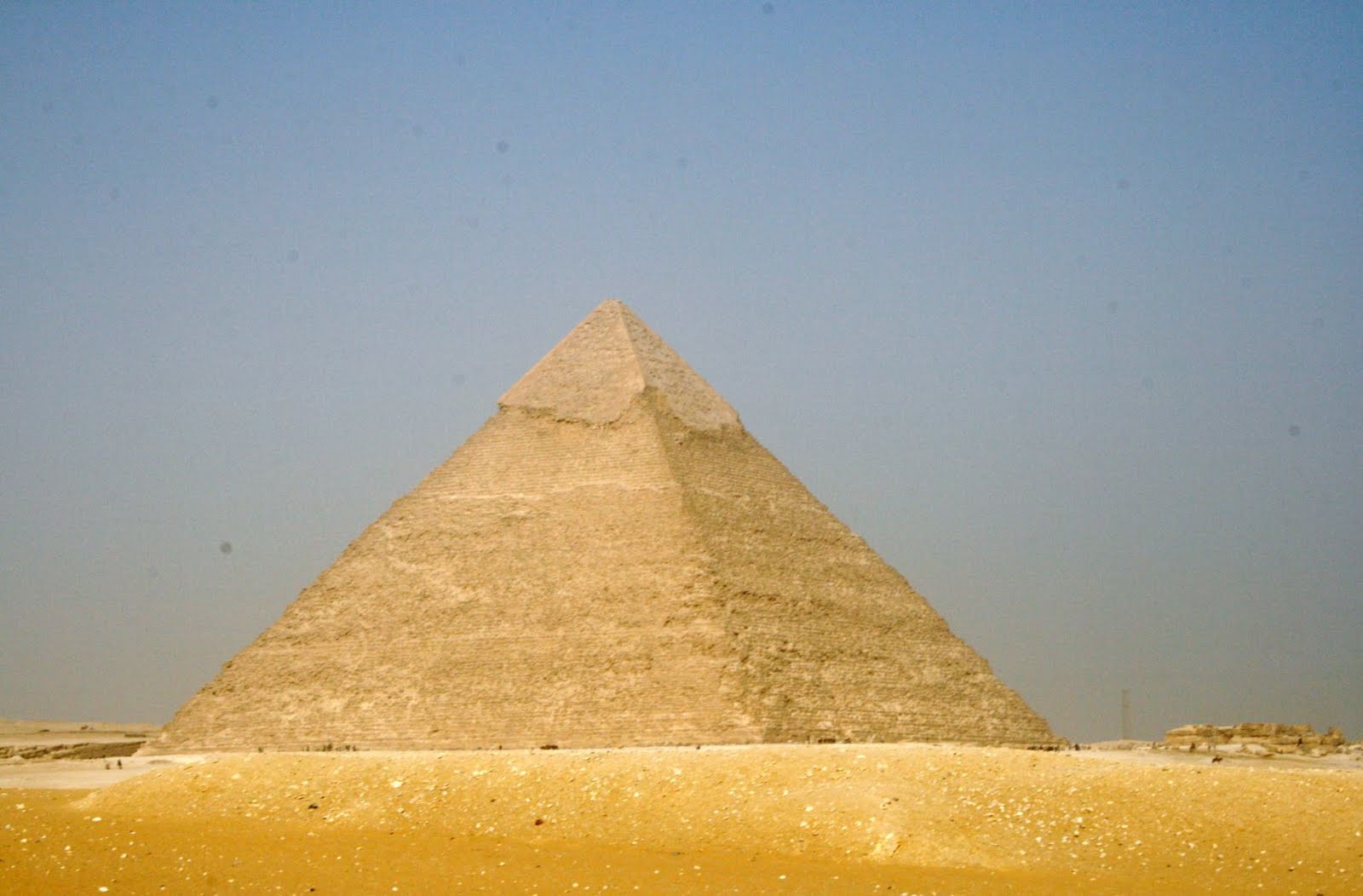
  Make a list of the world’s great ancient sites and amazing archeological finds and I am certain that Egypt will be on your list with the Pyramids of Giza the only of the Seven Wonders of the Ancient World still standing.  It is a site I have always wanted to see, and it is now a site I am glad to have seen.  I was in Egypt several months ago and the beginning of the journey I got a ride out to Giza in the morning and bartered for a camel and a guide.  My guide, a 25 year old Bedouin, hopped on a small horse, and I on a large camel, and we rode out through the desert and over sand dunes and hills, and though just outside the city, it felt like a real desert experience.  Only sand in rolling dunes lay in the views ahead of me, with camel and horses trekking through the emptiness of sand.  Camels are ornery creatures, and very large.  I felt tall riding on top of his humped back.  My camel was the tallest and biggest one I could find and the ride was a bumpy and wobbly experience, but there I was, riding a camel over sand dunes in the deserts of Giza staring at the great pyramids of Egypt.  There are many pyramids there, but three stand as the most famous and impressive, sitting tall in the middle, a giant collection of perfectly cut stone the color of the sand so wonderfully surrounding them.   I tried to imagine this site 4,000 – 5,000 years ago when it was built, juxtaposed in a harmonious contrast against an endless horizon and a sea of sand.  It would have been the tallest building in the world back then, and would have seemed all at once to be a giant geometric sand pile, how it blended in color, and also a great monument worthy only of gods, placed there by some other worldly beings.  They still stand majestic, but back then, can you imagine it? The pharaohs were all just kids in the sand box that is Egypt, stuck on building sand castles in the sun.


My camel and I, fast friends, moved along across the desert, snapping photos of sand and sky and monuments to ancient pharaohs.  How it must have been to be a pharaoh, convinced of your own deity.  Around the pyramids were burial sites of laborers who died in building them, and how it must have been to be a laborer and slave to the pharaohs.  Here I am, somewhere in between, and yet, better off than both.  Has any pharaoh ever trod the Great Wall of China, or hiked the steep mountainside of Wayna Pichu?  These pyramids are some of the greatest tourist sites in the world, and yet how many people will I ever meet who have been there.  Al Hamdulilah, Sadiqi.  Thanks be to God, my friend.  These pyramids loomed large, more impressive than I thought they would be, made so by the blankness and contrast of empty desert, by the camouflage of blending in to orange colored sands of desert.  They were massive, and alone, and proud in silence and solitude. 
  Of course, at Giza, I also saw the Sphinx, part man, part woman, part lion.  It sat down in resting pose, knowing it was the king of this jungle, this desert.  It seemed to guard over the pyramids, tombs of the pharaohs, patiently sitting as though resting in the shade, only regal in how it sat, how it stared and held its chin and gaze.  “Look at me, I am King.”  The pyramids were more impressive, due to size alone, though the Sphinx in carved out shape called for more inquiry, symbolic in the very parts of its body, man, woman, and beast.  I saw them all, pyramids and statues, tombs and temples.  I rode around the city and walked the hallways of the Egyptian Museum, filled with stones and statues, jewelry, board , and sketches made by slaves on limestone tabs, weapons and boats, and sarcophagi of kings and queens, and of course, the kings and queens themselves, their mummified bodies embalmed to last eternity.  Have you ever stared at a body nearly 5,000 years old and seen not bone, but skin and teeth and hair clinging to their emaciated frames?  They looked like the cursed souls from the Pirates of the Caribbean movie.  Their skin was taught and tight, shrunken and stretched out over bone, seemingly nothing underneath.  Their teeth were stained and rotting like a smoker’s addicted to sugar who never brushes. The hair was gray and yellow and coarse, and their eyes sewed in.  There are reasons that mummies have become creatures of fear and horror, dead bodies clinging obstinately to life, ghastly and ghoulish. 


I explored Cairo some, walking around the hectic filthy streets, and decided not to stay long, so I hopped aboard a night train headed for Aswan a long and cold ride through the dark night of a desert winter.  I arrived in Aswan and made it to a hotel near the rail station and immediately began to walk the city and the local bazaar.  It was different there in the south of Egypt than in Cairo.  It was much more traditional.  Everyone was dressed in robes and head scarves, following their Nubian traditions.  It is such a different desert than what we have in the UAE.  It is much more fertile, blessed with the winding waters of the Nile.  On the train ride down I stared out the window and it seemed I was back in Southeast Asia, with green, green fields and scattered palm trees around water buffalo and men out plowing and picking the fields in the light of early light of morning.  It surprised me to see such lush fields, showing that such immense waters as does the Nile provide can turn even a sandy desert  in to a fertile plain.  Most of the train ride down was farmland, and the desert reminded me of Arizona, with rocks and hills and the farms and fields, and how the trees and bushes mixed in with the sand and desert.  Yes, it is a better desert than we have in Ruwais.  It has a pastoral charm, with men in robes and scarves riding donkeys or camels through dirt roads of small stone and clay villages.  It is a life from years ago, with horse carts and mules and sand blowing from soft to harsh through towns landscaped around the desert.  Camels and donkeys were taken through villages and out to the desert or to markets as the only form of transportation for the Nubian and Egyptian people. 
  I took a small ferry out to the Temples of Philae, on a small island in the lake created by the Aswan and High Dams on the Nile River.  We slowly motored out to the island with the pillars of the temple rising above the reeds and tall grasses and flowering bushes around the banks of the island.  I walked around the temples, and inside gazing at statues and carvings of gods and goddesses, particularly Isis and Osiris, gods steeped in an ancient Egyptian love story.  The walls were covered in Hieroglyphics and carvings of priests and gods in human and animal form.  It was a sacred temple only for the priest who would bring offerings from the common people to serve to the gods.  Philae was impressive, but Upper Egypt, as Southern Egypt is called due to the flow of the Nile River running south to north, proved to hold more impressive sites. 


  I was also able to visit Abu Simbel, several hours south and near the Sudan border.  I hate being so close to a country and not being able to visit it.  On the drive down, I watched the sun rise up over that empty desert, casting shades of orange and yellow on to the sand, the colors of a genuine desert morning, where wind swept sands gathered and piled in perfect symmetrical mounds that looked from a distance like replicas of the great pyramids, but these were likely formed over hundreds or thousands of years by wind alone.  It was desert there, in every sense of the word. 
  Abu Simbel is a fantastic amazement.  There are two temples there, built under Ramses II, and wow, what a sight.  Each temple is carved out of the mountain, like an Ancient and Egyptian Mt. Rushmore, only with perfectly carved out rooms going deep in to the mountain, the stone walls inside perfectly preserving the hieroglyphics and intricate carvings and sketches on the flat smooth walls.  Many carvings and pillars stood inside the temple, detailed and beautiful sandstone brown, but most impressive were the enormous carvings of the pharaoh and gods carved out of the front of the mountain that guarded tall above the entrance.  Everything about the temple was fascinating and awe-inspiring, to think of such detail and intricacy carved in to a stone mountain.  Truly Abu Simbel must be among the most impressive monuments and temples in the world.  I walked it, and gazed at every inch of workmanship, such sites I have seen, such places I have been to. 


Monumental ancient artwork
Burial ground for pharaohs past
Tombs unlike another structure
Built to startle…built to last.
Reaching upward to an apex
Massive stones…each placed with care
Slowly bending to erosion
Centuries old…we find them there.
Mystic shapes claimed to have power
Health and wealth both to be gained
Geometric shape of wonder
Origins…left unexplained.
Filled with artifacts and treasures
Gold and silver, stone and clay
Placed beside the ancient ruler
Meant to help him…on his way.
Living in the plains of rulers
Sandstorms etch away their girth
Future years will find them missing
Lost within…the sands of earth.
 “Pyramids.” – M.E. Gaines.